Automatic garage door lubrication: where to grease (and where not to)
An automatic garage door is one of the largest, heaviest moving objects in your house — often over 300 pounds — supported by springs under enough tension to kill someone if they fail. The good news is that ten minutes of lubrication twice a year keeps the whole system quiet, extends spring life by years, and is the single cheapest form of preventative maintenance on any house. The bad news is that most people lube the wrong parts, skip the parts that actually matter, and use the worst possible product (WD-40, every time) to do it.
This guide walks the door end-to-end with photos. For each point, you’ll see exactly what the part looks like, what product to apply, and — just as important — which points to leave completely dry.
TL;DR: White lithium grease (spray or tube) on the torsion spring, hinges, bearings, and lock mechanism. Silicone spray on the rubber seal. Nothing on the tracks themselves — the rollers ride on them, they don’t slide. And never grease the opener’s drive chain with anything heavy — it’ll fling onto the ceiling.
Safety first: Never try to adjust or remove the torsion spring yourself. Lubricating the spring is safe — it’s done with the door closed and the spring untouched. Anything involving winding cones or cable drums requires a professional. Torsion springs store roughly 25,000 ft-lbs of energy; replacement is a $150–$300 service call.
Before You Start
- Close the door fully. You want the springs relaxed and the rollers accessible.
- Unplug the opener (or pull the emergency release cord). You don’t want the door to move mid-job.
- Wipe first, lube second. Use a clean rag to knock grit off hinges, rollers, and hardware. Grease over grit makes grinding paste.
- Keep a rag handy. White lithium grease overspray is sticky and hard to clean off paint and flooring.
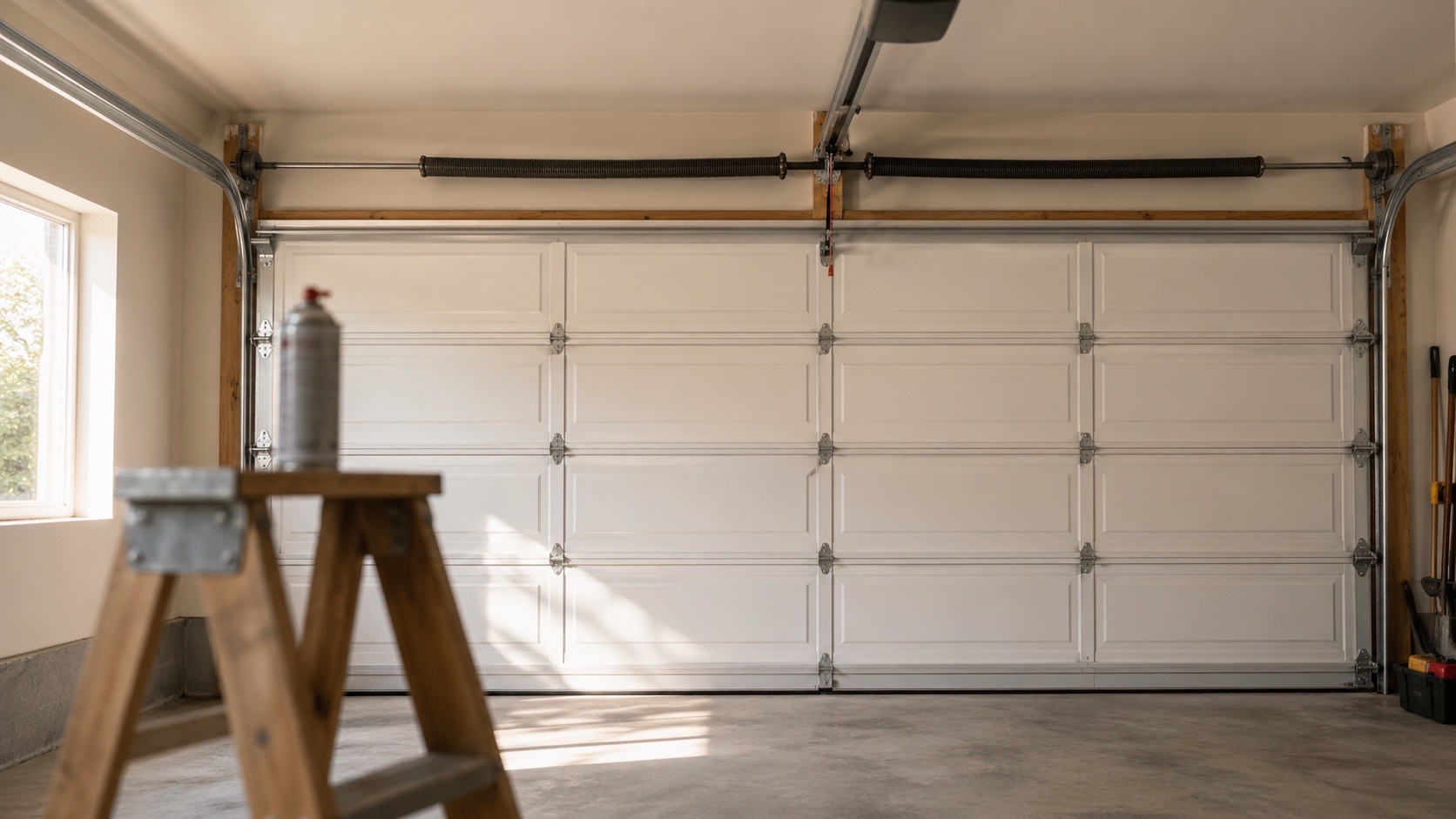
Point 1 — The Torsion Spring (Above the Door)
The big coiled spring mounted horizontally above the door header is the single most expensive component on the entire system. A dry spring rubs against itself coil-to-coil every cycle; those micro-contacts are what eventually cause snapped springs. A lubricated spring lasts 15,000–20,000 cycles. A dry, rusty one lasts 7,000.
Apply: White lithium grease spray, generous coverage along the entire length of the spring. Don’t be shy — the spring will rotate and distribute it. Wipe off any drips on the header afterward.
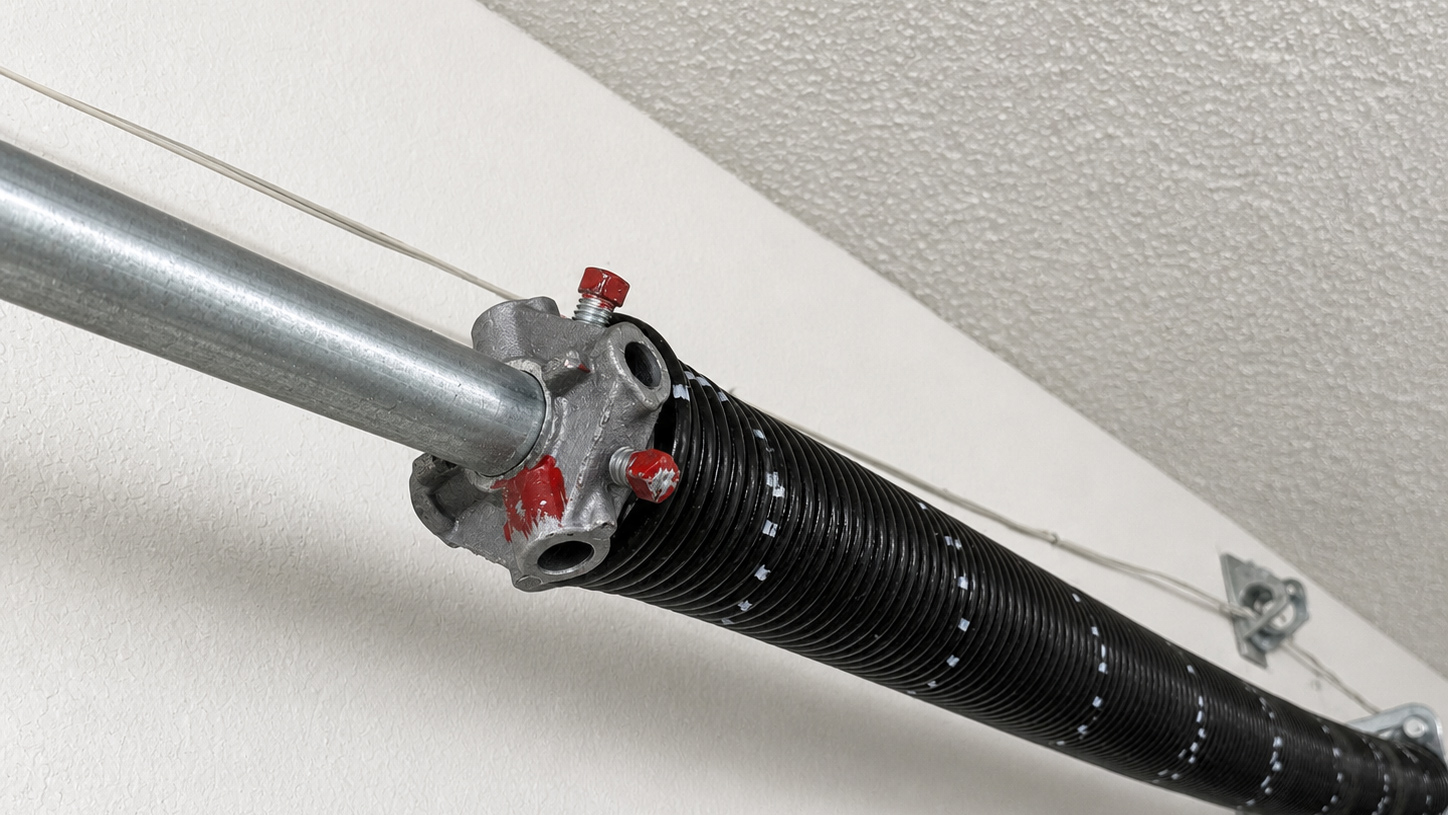
Never touch the winding cones (the red or black cast-iron fittings at each end of the spring with the adjustment holes). Those are under load even with the door closed. Spray past them onto the coil itself — don’t probe into the cone.
Point 2 — The End-Bearing Plates (Each Side of the Spring)
At each end of the torsion tube there’s a bearing plate bolted to the wall. Inside is a small bearing the tube rotates on every cycle. A dry end bearing is the #1 cause of the loud “machine-gun” rattling sound when the door opens — and it kills the bearing fast.
Apply: A short burst of white lithium spray directly into the bearing, aimed at the gap between the bearing race and the spinning tube. One or two seconds is plenty.
Point 3 — The Rollers (Both Sides, All the Way Up)
Rollers are the wheels that ride in the vertical and horizontal tracks. Each one has a stem with a small bearing where the wheel attaches to the hinge. That’s what you’re lubricating — not the wheel face, and not the track.
Apply: Spray straw aimed at the stem/bearing junction, one short burst per roller. Then open and close the door once manually (or with the opener) to work the grease into the bearing.
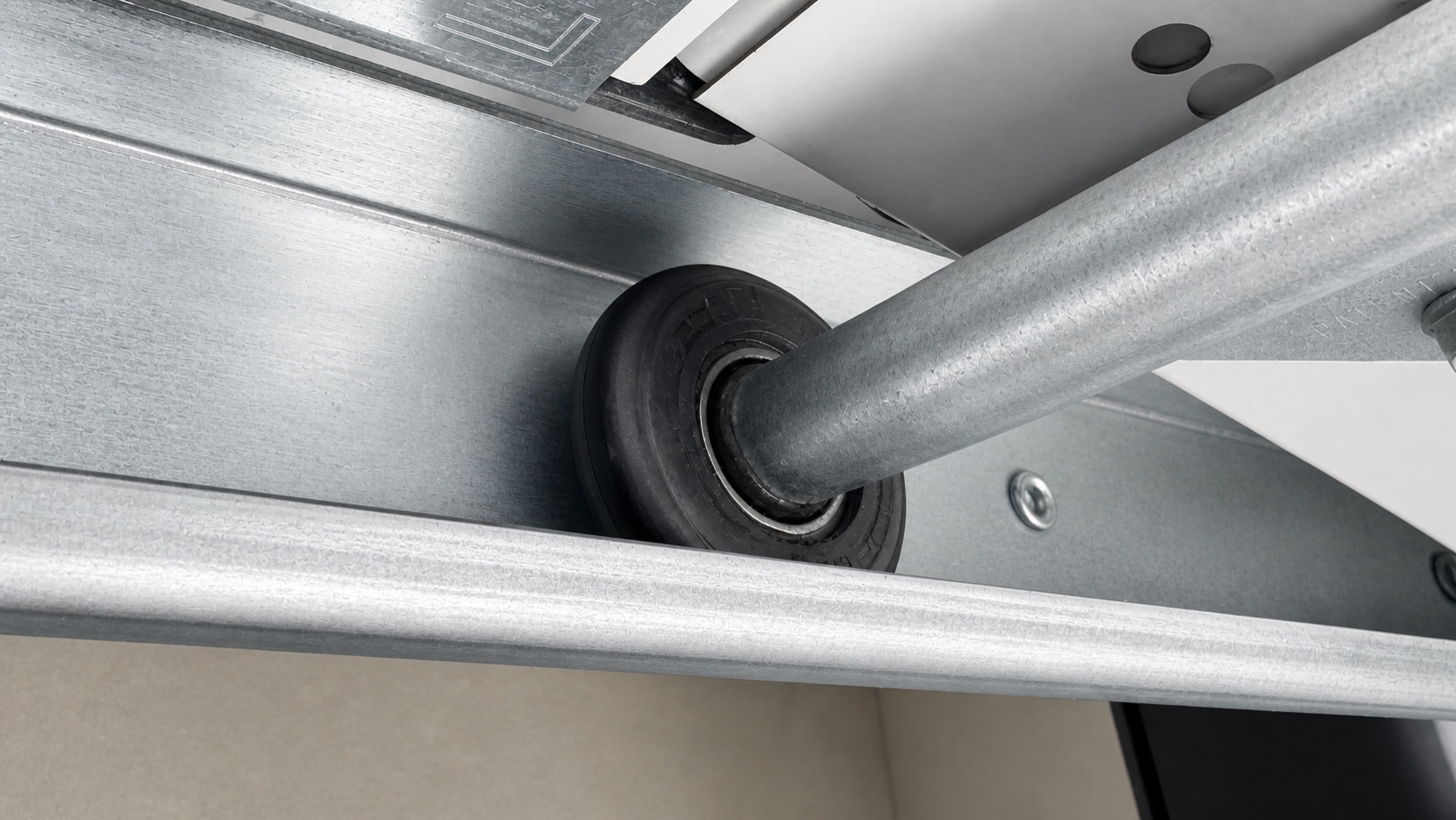
If you have nylon rollers (white plastic wheels, common on quieter modern doors), the wheel itself is self-lubricating — but the stem bearing still needs grease. Don’t spray the nylon wheel face, only the bearing.
Point 4 — The Hinges (Between Every Door Section)
Every hinge along the seams between door sections pivots slightly on each cycle. Dry hinges squeak, wear out, and eventually crack the bracket from cyclical stress. On a four-section door there are typically eight hinges (two per seam, three seams, plus end bearing hinges).
Apply: A drop or short burst of white lithium spray at each hinge pivot point. The goal is to reach the pin inside the hinge — open and close the door once afterward to work it in.
Point 5 — The Lock Bar and Keyed Lock (If Equipped)
If your door has a side-mounted lock bar that slides into the track (common on older doors and doors without automatic openers as backup), the sliding bar mechanism is a wear point. Modern opener-only doors often skip this entirely.
Apply: A drop of white lithium on the sliding bar pivot. For the keyed cylinder itself, use graphite powder or a dry PTFE lube — not grease, which gums up pin tumblers.
Point 6 — The Opener Drive (Chain, Screw, or Belt)
The opener itself has a drive mechanism running along the ceiling rail. Which type you have determines whether and how to lubricate it.
- Chain drive: A light coat of white lithium spray along the chain, door closed. Do not over-apply — excess chain lube flings onto the ceiling every cycle. Most modern chains come pre-lubricated and need attention only every 2–3 years.
- Screw drive: A thin film of white lithium grease applied by hand along the full length of the threaded rod. This is the drive type most sensitive to lubrication — dry screws are loud and burn out motors.
- Belt drive: Do not lubricate. The belt is rubber/kevlar and runs dry by design. Any oil or grease will degrade the belt and throw off tension. Clean with a dry cloth only.
Point 7 — The Bottom Rubber Seal (Silicone, Not Lithium)
The rubber astragal seal along the bottom of the door compresses against the floor every close cycle. In cold climates it freezes to the concrete; in hot climates it bakes and cracks. Lithium grease will actually degrade rubber over time — this is the one spot on the door where you switch products.
Apply: A light pass of silicone spray along the entire length of the rubber seal. This keeps it pliable, prevents ice-bond in winter, and slows UV cracking.
Where NOT to Apply Anything
These are the points where homeowners reach for a spray can and cause damage:
- The tracks themselves. The rollers roll, they don’t slide. Grease in the track does nothing for noise, and it collects dust that then coats the rollers. Wipe tracks clean with a dry rag — that’s all.
- The roller wheel faces. Only the stem bearing gets lubed. Grease on the wheel transfers to the track and makes the problem worse.
- The opener’s belt drive. Dry only. Oil degrades rubber.
- The safety sensors (photo-eyes). Never. Silicone overspray on the lenses causes intermittent reversal faults that drive people crazy.
- The keyed lock tumblers. Grease attracts grit; the lock will seize within a year. Dry graphite or a dry PTFE lube only.
The Three Products to Keep on the Shelf
WD-40 Specialist White Lithium Spray
Spray-on white lithium grease with a precision straw. Covers springs, bearings, rollers, hinges, lock bar, and chain-drive openers. One can lasts 2–3 years of maintenance on a typical residential door. This is the one product you reach for first.
Buy on AmazonLucas Oil White Lithium Grease
Tube-format white lithium for spots that need thicker coverage — screw-drive opener rails, heavy commercial-grade hinges, and end-bearing re-packing. Pairs naturally with the WD-40 spray: aerosol for most points, tube for the screw drive.
Buy on AmazonCRC Silicone Spray
Silicone spray for the bottom astragal seal and side weatherstripping — the one spot on the door where lithium grease would do harm. Also doubles as your go-to for sliding patio doors, car door weatherstripping, and other rubber-contact applications.
Buy on AmazonCommon Questions
Can I use WD-40 (the classic blue can) on my garage door?
No — it’s a solvent, not a lubricant. It’ll clean old grime off but evaporates within hours and leaves the hardware dry. The confusion is that WD-40 Specialist White Lithium is a completely different product in the same brand family; that one is a real lubricant and works beautifully. The trick is reading the label.
How often should I lubricate?
Twice a year is the standard recommendation — typically spring and fall. Heavily-used doors (farm buildings, daily-cycle commercial) benefit from quarterly attention. If you hear new noise between services, that’s the door telling you it’s time.
Why is my garage door still loud after lubricating?
Usually one of three things: (1) worn rollers that need replacement, not lubrication — typical lifespan is 10–15 years on steel rollers, 20+ on nylon; (2) loose hardware — hinge bolts, track brackets, and lag screws loosen over time and need checking; (3) tension imbalance in the springs, which requires a professional adjustment.
Should I lubricate the opener’s motor or gears?
No. The opener’s internal gearbox is sealed from the factory and runs on permanent grease. If it’s making noise, the unit is failing — not a lubrication issue. The only external part you lubricate is the drive chain or screw, as covered above.
Is graphite powder better than lithium for the lock?
Yes for the key cylinder — dry graphite doesn’t attract grit, which is what kills pin-tumbler locks over time. For the lock bar (the sliding piece), lithium is still the right choice. Two products, two different parts of the same mechanism.
How much does professional garage door service cost?
A full tune-up (lubrication, hardware tightening, spring balancing, roller inspection) runs $80–$150 in most markets. Spring replacement is $150–$300. DIY lubrication costs under $20 in product and replaces the tune-up portion of that service call.
Quick Reference
- Torsion spring: WD-40 Specialist White Lithium spray, generous coat along length.
- End-bearing plates: 2-second burst into each bearing.
- Rollers: Aim straw at stem bearing, one burst each. Never the wheel face.
- Hinges: One shot at each pivot pin (7–8 on a typical door).
- Lock bar: Lithium on the pivot. Graphite on the key cylinder.
- Opener: Chain → light lithium spray. Screw → Lucas tube grease by hand. Belt → nothing.
- Bottom rubber seal: CRC Silicone spray along length. Never lithium.
- Tracks, wheel faces, sensors: Leave dry.
For a filterable view across every home maintenance lubrication task — garage doors, sliding doors, hinges, locks, and more — the full lubricant guide lets you filter by rubber safety, temperature range, and form factor. The per-item pick for this topic is garage door lubrication.
ThePickSmith participates in the Amazon Associates program. Purchases made through links on this page may earn us a commission at no extra cost to you. Product recommendations are based on independent research and not paid placements.