Lube substitutes in a pinch: what's in your house that actually works
It’s 9 PM on a Sunday, the drawer won’t slide, the zipper on your jacket is stuck, or the bedroom door is squeaking loud enough to wake the kids — and you don’t have the right lubricant for any of it. You could run out to the hardware store in the morning. Or you could reach into the bathroom cabinet, kitchen drawer, or toolbox and find something that’ll hold you over for the next week. This guide is the honest reference for exactly that: what works, what doesn’t, and how long the improvised fix will actually last before you need the real thing.
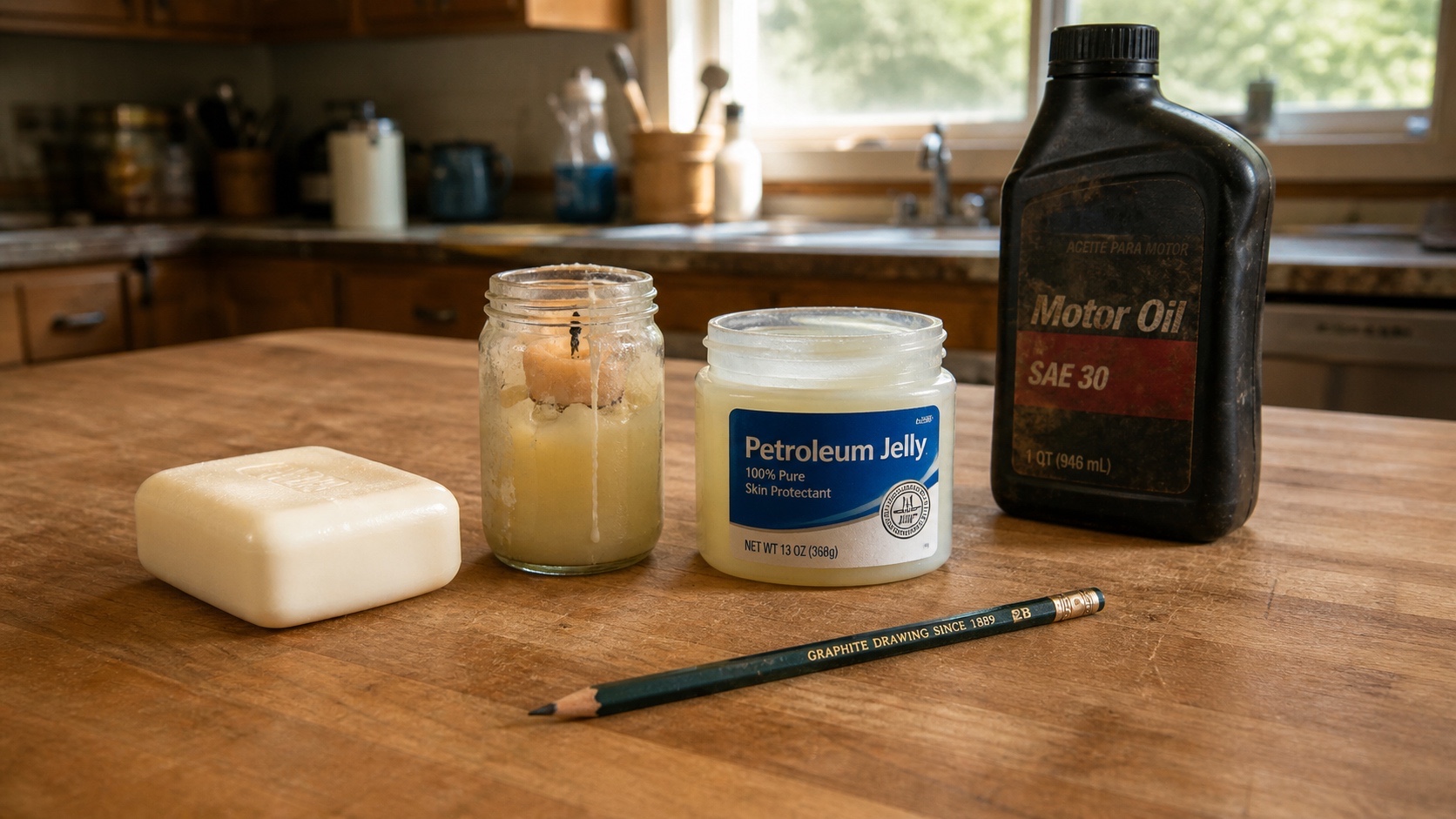
TL;DR: Candle wax is the single most useful household substitute — it works on wood drawers, window tracks, zippers, and stuck screws. Petroleum jelly is second, good for door hinges and O-rings. Motor oil is an emergency firearm lubricant that works surprisingly well for a few hundred rounds. Cooking oils, hair products, and anything water-based belong nowhere near your mechanical parts.
The Reference Table
Rows are things you might need to lubricate. Pick the first green substitute on the row that matches something you own. The rightmost column is the permanent fix — which you should get around to eventually.
| You need to lube… | Best household substitute | Works because | How long it’ll last | Don’t use | Permanent fix |
|---|---|---|---|---|---|
| Squeaky door hinge | Petroleum jelly (Vaseline) | Clings to the pin, non-drying | 3–6 months | Cooking oil, WD-40 (solvent) | White lithium or silicone grease |
| Wood drawer that sticks | Candle wax / paraffin block | Dry, slick, doesn’t swell the wood | 1–2 years | Any oil — soaks into wood | Paraffin block or beeswax stick |
| Metal drawer slide | Bar soap (dry, rubbed on) | Creates a dry slick film | 2–4 months | Motor oil, butter | White lithium spray |
| Stuck zipper | Graphite pencil, candle wax, or lip balm | All three reduce tooth friction | Several uses | Oil, cooking spray — stains fabric | Zipper-specific wax stick |
| Squeaky floorboard | Baby powder or talc | Fills the gap between boards, kills the rub | Weeks to months | Any oil — seeps into finish | Powdered graphite or wax-based product |
| Rusty / stuck bolt | Penetrating oil DIY: 50/50 ATF + acetone | Acetone carries ATF into the thread gap | Single use | WD-40 alone (it’s not a penetrant) | Kroil or PB Blaster |
| Pliers / scissors pivot | A drop of 3-in-1 oil or mineral oil | Light enough not to attract much grit | Months | Motor oil (too heavy), WD-40 | Tool-specific oil or Break-Free CLP |
| Sticky window track | Candle wax or bar soap | Dry film, doesn’t attract dust | Season | Petroleum jelly — attracts dust | Silicone spray |
| Cabinet hinge squeak | Petroleum jelly on a toothpick | Stays put, won’t drip onto cabinet | 6+ months | Spray lubricants — overspray | White lithium or silicone grease |
| Lock / deadbolt | Graphite from a soft pencil (#2B+) | Dry lube — doesn’t attract debris inside cylinder | Months | Any oil — gums up the cylinder | Powdered graphite or Tri-Flow |
| Firearm slide / action (emergency) | SAE 5W-30 motor oil, 1 drop per rail | Motor oil is a high-quality lubricant — just not purpose-built | 200–400 rounds | WD-40, vegetable oil | Slip 2000 EWL or Break-Free CLP |
| Bike chain (emergency) | A few drops of 3-in-1 oil | Light oil penetrates pin/roller gap | One ride home | Motor oil, cooking oil, butter | Wet or dry chain lube |
| Sewing machine | Food-grade mineral oil (one drop) | Clear, thin, safe on fabric | Light use only | Motor oil — stains fabric | Sewing machine oil |
| O-ring / rubber seal | Petroleum jelly (on nitrile/EPDM only) | Won’t swell compatible rubber | Months | Silicone lubricant on silicone O-rings (swells them) | Silicone grease or food-grade dielectric |
| Garage door opener chain | A light coat of 30W motor oil | Chain + roller design is forgiving | Season | White lithium (wrong application), WD-40 | Garage-door-specific lithium spray |
| 3D printer lead screw | None — do not improvise here | Household oils attack POM nuts or go rancid | N/A | All cooking oils, Vaseline, WD-40 | Super Lube synthetic PTFE grease |
The Three Heroes of the Household Toolkit
1. Candle Wax / Paraffin Block
If you could only own one improvised lubricant, it would be a plain unscented candle or a paraffin block from the canning section of the grocery store. Rub it on wood drawer runners, window tracks, zipper teeth, wood screw threads, saw blade teeth, and the bottoms of skate decks. It’s dry, doesn’t stain, doesn’t attract dust, and lasts months. Every serious woodworker has a chunk of paraffin within reach. The specialty products that compete with it (Bostik GlideCote, Sandaraic wax sticks) are basically the same wax with a handle.
2. Petroleum Jelly (Vaseline)
A mineral-oil-based semi-solid that clings where you put it. Excellent on metal-on-metal pivots that need something more than oil but where a grease tub is overkill — door hinges, lock mechanisms (externally, not inside the cylinder), cabinet hinges. Petroleum jelly is not food-safe, attracts dust in open environments, and will swell natural rubber. But on an indoor hinge it’s great for 6+ months.
3. Graphite (From a Soft Pencil)
The side of a #2 or softer pencil rubbed onto a key, a lock latch, or a stuck zipper deposits powdered graphite — a real dry lubricant used in aerospace and industrial applications. Shake the key in the lock a few times after rubbing the graphite on and the friction drops measurably. The difference between this hack and the real thing (a squeeze tube of powdered graphite for $4) is quantity, not chemistry.
The Things People Reach For That You Should Not Use
Bold rule: If it’s edible, it doesn’t belong on metal long-term. Cooking oils — olive, vegetable, canola, coconut — all go rancid. Rancidity means they polymerize into a sticky varnish that’s harder to clean off than the original problem. The one exception is food-grade mineral oil (the kind sold for cutting boards), which is chemically stable.
- WD-40 (the blue-and-yellow can): It’s a water displacer and light cleaner, not a lubricant. It’ll feel like it worked for two hours, then leave the part drier than before. WD-40 has its own product line of actual lubricants (White Lithium, PTFE, Dry Lube, Silicone) — those are fine. Just not the classic formula.
- Cooking oil (olive, vegetable, canola): Goes rancid, polymerizes, turns gummy. Do not use on anything you expect to still work in 6 months.
- Butter, margarine, lard, bacon grease: Same problem as cooking oil, with added stink.
- Hair conditioner: People recommend this for bike chains online. Please don’t. It’s a water-based emulsion; the water rusts the chain.
- Hand sanitizer: Alcohol will strip whatever lube is there and evaporate. Makes things worse.
- Dish soap / body wash: Water content = rust. Residue attracts more grit than it prevents.
The Firearms Exception — Motor Oil Actually Works
There’s a long-running myth that you’ll destroy your gun by running it on motor oil. You won’t — at least not in any measurable way for several hundred rounds. Motor oil is a high-quality lubricant engineered for metal-on-metal contact under far more extreme conditions than what a Glock slide experiences. Soldiers in WWII and Vietnam routinely lubricated rifles with whatever oil was in the motor pool.
The reason you shouldn’t use it long-term is that motor oil is designed to carry combustion byproducts — soot, metal shavings, acids — into a filter. Your gun has no filter. Over many thousands of rounds, that carbon builds up faster than with purpose-built gun oil. But for a weekend range trip or a truck-gun emergency? It works. Same goes for ATF (automatic transmission fluid) — if anything, it works better than motor oil because of the detergent package.
For the long-term story, the Glock lubrication guide covers what actually belongs on the slide rails.
Common Questions
Is WD-40 a lubricant or not?
It’s a mild penetrant and water displacer with some short-term lubricating properties. The WD in the name stands for “Water Displacement,” and the 40 was the 40th attempt at the formula. If you spray it on a hinge it’ll quiet the squeak — for a few hours. Then it evaporates and the hinge is worse than before. The related specialty products (WD-40 Silicone, Lithium, PTFE) are fine lubricants; the classic can isn’t.
Can I mix household items to make a better substitute?
The classic is 50/50 ATF and acetone as a penetrating oil for stuck bolts. It genuinely works — independent machinist-shop tests rank it competitive with Kroil. That’s the only DIY mix worth bothering with. Mixing cooking oils with wax or petroleum jelly just gives you a messier, rancid version of each.
I heard you can lube a bike chain with olive oil. Can I?
Technically yes, for one ride. It’ll rust the chain in days and turn sticky within a week. Use it only if you’re truly stranded and need to get home. Then clean the chain thoroughly and apply real chain lube.
What about in extreme cold? Does any household item work?
Powdered graphite and candle wax both work well below freezing — they’re solid at room temperature and don’t thicken further. Petroleum jelly stiffens noticeably below 20°F and becomes nearly unusable below 0°F. Synthetic gun oils and specialty products far outperform any household substitute in real winter conditions.
Is silicone spray household or specialty?
It’s usually sold in the household aisle (Home Depot, Lowe’s) but it’s a real lubricant — not a substitute. A $6 can of silicone spray is arguably the single best general-purpose lubricant you can keep in a garage, good on rubber, plastic, metal, and fabric without staining or attracting grit. If you’re shopping for a true “one can does most things” option, silicone spray beats WD-40 by a wide margin.
Quick Reference
- Keep on hand always: plain candle, small jar of petroleum jelly, a #2 pencil, can of silicone spray.
- Firearms emergency: 5W-30 motor oil — one drop per rail, works for a few hundred rounds.
- Stuck bolt: 50/50 ATF + acetone, let it soak 15 minutes before turning.
- Wood drawer: rub the candle on the runner. Lasts 1–2 years.
- Door hinge: Vaseline on the pin with a toothpick. Lasts months.
- Lock: rub a soft pencil on the key, insert, work the key a few times.
- Do NOT substitute for: 3D printer screws, sewing machines (long-term), food-contact surfaces, anything with nylon/polycarbonate (oils can crack plastic).
For specific-part recommendations across every maintenance task — not just the improvised ones — see the full lubricant guide, filterable by food safety, temperature range, and material compatibility.
ThePickSmith participates in the Amazon Associates program. Purchases made through links on this page may earn us a commission at no extra cost to you. Product recommendations are based on independent research and not paid placements.